
How AI Audio Changes Editorial Workflow: Speed, Repurposing, and the New Publishing Math
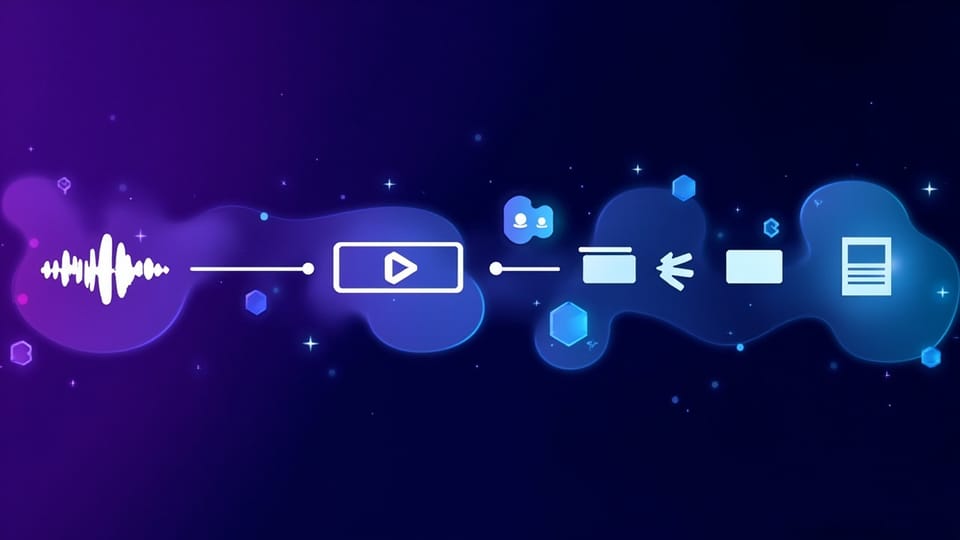
One Article. One Workflow. Dozens of Formats.
Here's what's actually changing in publishing newsrooms in 2025: publishers aren't just experimenting with AI anymore — they're rebuilding their editorial workflows around it. And the most impactful shift isn't about cutting costs. It's about speed and repurposing. How fast can one article become a podcast, a video, a newsletter, and ten social clips? The publishers winning in 2025 are answering: faster than ever.
The Old Workflow vs. The New Workflow
Traditional publishing workflow: write article, publish, move on. Maybe a social team repurposes a quote or two. Maybe someone downloads the audio and manually edits a podcast. Weeks of potential content, lost.
The new workflow enabled by AI audio tools is fundamentally different: write once, automatically generate audio, clip for social, summarize for newsletter, embed in video. One piece of content, working across every platform simultaneously.
Arc XP's 2025 survey found that 86% of publishers report reduced labor time through AI. 85% report faster content creation. These aren't marginal improvements — they're a complete restructure of the production cycle.
What Actually Changes in the Editorial Process
Before automated audio production:
Editor reviews article, sends to audio team, voice actor records, engineer edits, QA, publish. A typical audio version takes 3-5 business days minimum. For a daily publication, that's not sustainable. Audio becomes a 'nice to have' that rarely ships.
After automated audio production:
Editor clicks 'generate audio', AI produces broadcast-quality narration, automated QA, publish. Total time: under 5 minutes. Audio ships with the article, not weeks later.
AudioStack reports publishers producing broadcast-quality audio content 99% quicker than traditional workflows. Podigee's tools handle one-click publishing, noise reduction, and audio leveling automatically. The bottleneck used to be human recording time — that bottleneck is gone.
Repurposing: The Multiplier Built Into the Workflow
The speed improvement is real, but the bigger story is repurposing. When audio is a first-class output — not an afterthought — every article becomes a content hub. The podcast you publish becomes the source for:
• Short-form audio clips for social (automatically extracted)
• Transcribed quotes for social graphics
• AI-generated summaries for newsletters
• Translated versions for international audiences
Social Peak Media documents how Opus Clip and Descript's Clip identify engaging moments in long-form audio and extract them as shareable short-form video — automatically. One podcast episode becomes dozens of derivative assets.
This is what we call liquid content. The math is simple: one piece of content, working harder across more formats, reaching more audiences.
The Numbers Are Compelling
99% faster audio production with AI workflows (AudioStack, 2025)
86% of publishers report reduced labor time through AI (Arc XP / Digiday, 2025)
85% report faster content creation (Arc XP / Digiday, 2025)
75% of publishers exploring text-to-audio conversion (Reuters Institute, 2025)
B projected creator economy by 2027 (Goldman Sachs)
67% drop in Facebook referral traffic for publishers in 2 years (Reuters Institute)
Why This Matters for Your Editorial Team
Publishers without an AI audio strategy are outpacing competitors who haven't made the shift. They're not just publishing faster. They're building a content system where every article compounds in value over time.
The question isn't whether AI audio production will become standard in publishing. 87% of newsrooms say they're already being transformed by Gen AI (Reuters Institute, 2025). The question is whether your workflow is ready to keep up.
If you're still treating audio as a separate project, a separate team, and a separate week — the data suggests you're leaving reach, engagement, and revenue on the table.
Ready to Transform Your Editorial Workflow?
BotTalk's AI audio platform lets publishers generate broadcast-quality audio from any article in minutes — not days. No voice actors, no studio time, no bottlenecks.
Join leading publishers already running liquid content workflows with BotTalk. See how it works. Book a demo or start your free trial today.
Sources
Pugpig: Digital Publishing in 2025 — Creators, AI and the Platform Shuffle
Reuters Institute: Journalism, Media, and Technology Trends and Predictions 2025
Digital Content Next: The Year of Now — An AI Turning Point for Publishers
Social Peak Media: Podcast Production and Editing Guide 2025
Podglomerate: Best AI Tools for Podcast Production 2026